We've moved! Please visit our blog at igotyourrug.com/oriental-rug-blog

IGotYourRug.com ~ 4153 Virginia Beach Blvd., Virginia Beach, VA ~ 757-486-6600

Showing posts with label area rugs. Show all posts

Wednesday, March 21, 2012

Trends for Area Rugs for 2012 and Beyond

Mark at Domotex in Germany - the Largest International Rug and Design show

This past January my daughter Lauren, whom we call Lolly, accompanied me to Germany to attend Domotex, the largest International rug and design show. The theme of Domotex 2012 was “Customized Living” and that is really what home décor is all about.

“The design options are endless - silk or wool, traditional patterns or futuristic modern design, vibrant colours or subtle hues, modern carpets woven to customer specifications or carpets and carpet tiles arrayed in different colour combinations and shapes. It is easier than ever to achieve an individual, stylish effect.” (Quote from Domotex website)

We very much agree with that statement and at Mark Gonsenhauser’s we strive to bring you the latest designs in rugs and carpets, as well as the ability to customize and create what will fit your needs and desires.

We saw some amazing innovations in rug and carpet designs. Below I showcase three new trends that we liked and have brought to our store in 2012.

1- Silk Sari Rugs. Beautiful hand made 100 % silk rugs made from leftover production fabric and recycled silk sari's. No two rugs are alike! 

Beautiful and Bright Hand made 100 % Silk Rug 
made from recycled Silk Sari's

100% Silk Rug made from recycled Silk Sari's

2- Another innovative idea in rugs for 2012 is Over Dyed Rugs. Some of the rugs are vintage or recycled pieces of rugs sewn together. The process involves neutralizing the colors of the original rug, while still maintaining the pattern and design of the rug.  The rugs are then re-dyed with a solid color producing a unique effect.

Over dyed Rugs at Domotex 

3- Ikat Hand Loomed Rugs. Ikat is a style of weaving where a dyeing technique is used to create a pattern. Ikat employs a resist dyeing process similar to tie-dye on either the warp or weft fibers. The fibers are then woven to create a pattern or design.

Ikat Rugs at Domotex


Ikat Rug - Hot trend in rugs for 2012 and beyond! 


After Domotex we traveled to India to buy rugs. This was a very productive trip because David and Lolly learned about the rug buying process as well as the rug making process.

At the Taj Mahal
A rug maker hand serge's the side of a rug
  
My children passionately offered their opinions on the rugs I purchased and gave me the perspective from their generation. Lolly was even inspired to design her own line of flat weave Dhurrie's exclusive to our store fittingly called “The Lolly Pop Collection.”

Lolly and the "Lolly Pop" Dhurrie collection

"Lolly Pop" Dhurrie Rugs

We also made a visit to the Siddharth Gonsenhauser School where we toured the new second floor they built since my visit last year.

Mark with the kids at the Gonsenhauser sponsored school in Siddharth India


It was an amazing trip and I am excited about bringing to you all the beautiful rugs that I bought for the store! Come in and see us soon!


"I Got Your Rug!"

Mark Gonsenhauser's Rug and Carpet Superstore 
4153 Virginia Beach Blvd.
Virginia Beach, VA 23452
757-486-6600 


Wednesday, December 28, 2011

What Rug For What Room?


Rug  Size & Room Chart
Beside the obvious questions of color and style to be decided by an individual’s personal taste, to determine what type of rug or what size rug is needed for a given location, you should take several factors into consideration.


Of course, price will play an important role in that decision. Within your budgetary parameters, however, the type of construction and quality you choose will be a key factor in ensuring that you will be happy with your new purchase. Putting a light colored needlepoint runner in a foyer or hallway is not usually recommended. Why? Even top quality needlepoints are not made to stand up to high traffic, especially in entry areas where dirt and salt can damage the rug. Conversely, a beautiful soumak flatweave, which has a much denser construction to resist dirt and traffic, could be perfect for such an application. The needlepoint can be a wonderful addition to a bedroom room, a “barefoot” area, where the soumak with its rougher texture might be less desirable from a comfort standpoint. These are just two examples of how placement of different constructions should be taken into consideration.

Another factor you will certainly want to consider is size. From small scatter rugs to palatial carpets, both the actual room size and the specific decorating scheme are critical in determining the size of the rug best suited to your needs. Dining room rugs need to be sized for the placement of the chairs and the table as well as for the absolute measurements of the room. Take into account how much of the pattern will be hidden or obscured under the table. Obviously, a center medallion design would not be the ideal choice for this purpose.

Living rooms can have a wide array of layouts and elements. Sofas, chairs. occasional tables, and lighting fixtures can be arranged in a single unified configuration or in separate seating or "conversation" areas. In either case, your rugs should play a key role in focussing and enhancing the placement of your other furnishings. In effect, they should function as the "foundation" of your design plan for any area in which they are used. The possibilities of decorating with rugs are endless, and with the Nourison family of collections, you can be assured of the very best in color, design, and quality for every room in your home.


Source: http://nourison.com/main.aspx?FORM=NU3


At Mark Gonsenhauser's we can help you choose the right rug for the right room! 


I Got Your Rug!

Mark Gonsenhauser's Rug and Carpet Superstore 
4153 Virginia Beach Blvd.
Virginia Beach, VA 23452
757-486-6600 


Website: http://www.igotyourrug.com/ 

Wednesday, August 17, 2011

Pull the rug out ... and repair it


By Krys Stefansky
The Virginian-Pilot
July 31, 2011


Sometimes magic carpet rides fall to earth. Beautiful, patterned Oriental rugs, even expensive, high-quality ones from the far reaches of the globe, have accidents.

Bound edges come undone from wear or mishap. Furniture and foot traffic wear down their pile.

Fringe gets caught in doors, tangled in vacuum cleaners, gnawed by four-legged friends.
No matter how painstakingly they are made – by villages or nomads, on looms of wood or metal, knotted in the Persian style or Turkish, hand tufted or machine-made – eventually, they are dirtied by shoes, spilled on by partygoers, spit up on by crawling babies, tinkled on … and worse … by naughty pets.

Rugs with spots and rips or entire missing chunks make their way to rug repair rooms, if they’re lucky.


There, attention and mending makes them presentable again. Their once-dilapidated state stops being an embarrassment to their owners. Lovingly restored, they return to full glory.
But a good transformation doesn’t always happen without some homework.


Choose a rug restorer with care; No. 1 is the shop’s reputation. No.  2 is to ask and decide whether they really sound knowledgeable. No.  3 is to ask to see other repairs they have done. There are a lot of companies that do the wrong things.


The workrooms at Mark Gonsenhauser’s Rug & Carpet Superstore in Virginia Beach stay busy.
“When a rug comes in for cleaning and is damaged as well,” Gonsenhauser said, turning to a computer in his showroom, “we begin here.”


A menu of services offers spruce-ups like deodorizing, moth-proofing, mildew treatments, urine removal, color touch-ups, hand-serging, patching, turning fringe under. The list goes on and on.
“This is America,” Gonsenhauser said, joking. “You can have what you want.”


Most often, Oriental rugs are re-fringed, rebound, straightened, rewoven or cleaned, he said. Customers looking to protect their original investment often say, “Do whatever it is that you need to do.”
Back in the 1970s, Gonsenhauser, who learned the rug business from his father, studied the art of rug repair in Iran.


Owning a rug that looks a bit disheveled doesn’t necessarily mean it’s been abused.
The finest and best rugs will eventually show wear, he said. The sides of an Oriental rug – the bound edges, or selvages, that act like bumpers on cars – come undone or wear thin with time. If the selvage damage gets bad and eats into warp and weft (the threads that form the rug’s canvas backing), the patterned edges of the rug itself might need reweaving and re-piling. At the ends of the rug, fringe wears off and, if left unattended, so do the warp threads of the rug itself.
“In our business, it’s a stitch in time saves nine,” Gonsenhauser said. “You have to catch the damage before it gets worse.”


Taking action sooner rather than later is advice common to the business.


To make repairs to a rug’s pile, Gonsenhauser’s rug restorers use wool imported from India, Nepal or England and wools that are semi-worsted, hand-spun and machine-spun. The options allow restorers to capture subtleties in color and thickness.


“This is the heart of our repairing,” he said, touching hanks of different kinds of wool hanging from racks. “You’ve got to have the wool.”


Gonsenhauser also keeps a stack of salvaged pieces of old rugs so that, rather than reweaving, which can become expensive, patches can be fashioned.


Upstairs in his repair shop, an antique, 150-year-old Persian Hamadan colored with vegetable dyes was recently restored down to the warp and weft threads, which were rewoven before carefully selected strands of wool in varying shades were knotted, two strands at a time, into the canvas to re-pile the rug.


Typically, repair work is hardly more modern than the tools and techniques originally used to make the rug.


In this case, the area being worked on lay over a section of pipe. Beeswax lubricated the curved needles or hooks going through the tight canvas. Knots were tied by hand. Simple pairs of scissors snipped the wool to the right height.


Success or failure lies in the hands of the person doing the repair.


“To do it right, you’ve got to have a sense of mix and match and of how to monkey around a little bit to get the wool right, the color right, the knots right. To be a good restorer, you have to be in tune with the rug,” Gonsenhauser said. “You’re always learning another trick. It’s ultimately in the eye and hands. Anybody can make wine, but certain people make great wines. It’s the same thing here.”


The cost of minor repairs can be small compared to the original cost of a rug.


Gonsenhauser pulled a machine-made Karastan out of a storage bin. A 1-inch-diameter hole had to be rewoven. It would cost the owner $120 to re-pile the spot and $99 to clean the 6-by-9-foot Karastan, a small investment for a rug that once sold for $1,800.


Some damage can’t be pinned on a single incident. It can come from a lack of regular care and can be prevented at home.


People think rugs wear out from frequent walking on them.
“In reality what goes wrong is that sand gets into the pile and acts as an emery board, cutting off the wool,” Gonsenhauser said.


He recommends that, besides regular vacuuming, every six months or so rug owners employ a simple trick. Flip the rug and vacuum the back. Dust and sand will fall out onto the floor, where it can be swept up and the rug’s pile freed of abrading debris.


Mark Gonsenhauser's Rug and Carpet Superstore 
4153 Virginia Beach Blvd.
Virginia Beach, VA 23452
757-486-6600 


Website: http://www.igotyourrug.com/ 


Proudly providing you Professional, Expert Rug Repair and Restoration for the Hampton Roads cities of Virginia Beach, Norfolk, Chesapeake, Portsmouth, Suffolk, Hampton, Newport News. Northeastern North Carolina and the Eastern shore.


Thursday, March 25, 2010

Hand Made vs Machine Made Rugs


Hand knotted Rug in Ikat style design


How to tell the difference between a hand made and a machine made rug

To an untrained eye it may be difficult to tell the difference between hand knotted, hand made and machine made rugs. This guide will help you understand the differences.


Hand Knotted Rugs


Parts of a hand knotted rug

Hand knotted rugs are made on a specially designed loom and are knotted by hand. The rug weaver inserts the "knots" into the foundation of the rug and they are tied by hand, this makes up the "pile" of the rug. (Click here to read our post about the knot count of hand knotted rugs.) 

Hand knotted rugs can be made of wool, cotton, silk, jute and other natural materials. Silk is sometimes used in wool rugs for the outlines or highlights of the pattern to enhance the design. Hand knotted and hand woven rugs can last many generations if they are of good quality and properly maintained.


Flat Weave or Hand Woven Rugs


Flat Weave Rugs have no pile

There is also a category of hand made rugs called "flat weave." These rugs are hand woven in a flat weave pattern and there is no pile.


A typical small rug loom for hand knotted or flat woven rugs


Machine Made Rugs

Machine made rugs are made by large machines called power looms. A power loom is electrically automated and controlled by computers. Machine made rugs can be made quickly and are manufactured with materials including wool and synthetic fibers such as polypropylene, nylon, acrylic and art silk. Machine made rugs can offer a lower price alternative to hand knotted rugs. Machine made rugs usually have a life span of about 20 years. There are exceptions if the rug is high quality and well maintained, it can hold up for much longer. Machine made rugs are generally not of any value to a collector.


Back of a machine made rug. Note the uniformity of the stitching which is done by a machine

Hand Crafted Rugs or Hand Tufted Rugs

Hand tufted rugs are another type of rug that is considered hand made or hand-crafted. This particular type of rug is made using a modified hand held drill gun that inserts the pile into a cloth foundation which creates a loop pile. If the loop pile is sheared, it then becomes a cut pile. The loop pile rug, if not sheared, is called a "Hand-Hooked" rug. Some designs have both loop and cut pile combined to create a dimensional effect to the pattern. A latex coating is then applied to the back of the rug to hold the "tufts" in place. A canvas type fabric is then applied over the latex coating to finish the back of the rug. 

These rugs have a hand made look but they cost much less because using the gun speeds up the process dramatically. For example a good quality 8' x 10' hand knotted rug might take about 10 to 14 months, while the same size rug made in a hand-tufted method might take one day. 

Although Hand Tufted rugs can be just as beautiful as hand knotted rugs, they typically are not of value to a rug collector or someone who is looking to buy an Oriental rug as an investment. 


Back of a Hand Tufted Rug


Look at the Back of the Rug 

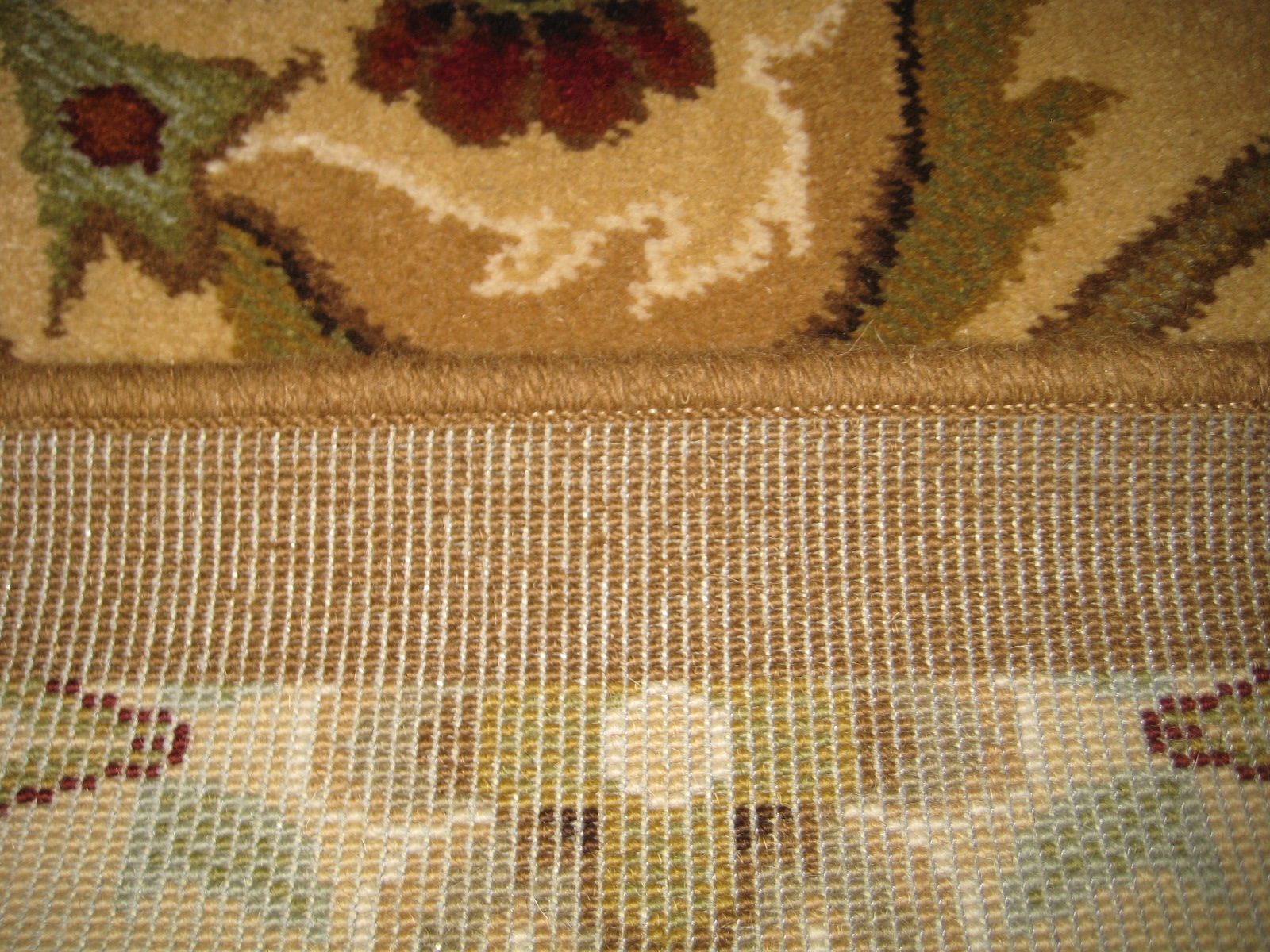
One of the best ways to tell the difference between hand knotted and machine made rugs is to look at the back of the rug. In hand knotted rugs the weaving and the knots will be slightly uneven and not perfectly uniform. On the other hand, a machine made rug will look very uniform and perfectly even. The more detail in the design when looking from the back, the better the quality of the rug. 


Back of a Hand Knotted Rug. Note the fringe is part of the rug.


Back of a Machine Made Rug. Note that the fringe is sewn on.


Look at the Fringes of the rug 

Another way to determine if a rug is hand knotted or machine made is to look at the fringes. As you can see from the picture above, the fringe of a Machine made rug is sewn on and is attached as a finishing touch. 

The fringe of a hand knotted rug is an extension of the rug foundation, as in the picture below.


The foundation of a Hand Knotted rug becomes the fringes.


We hope this has been helpful! Come by our showroom and we will be happy to help you find the perfect rug for your home or office!


Mark Gonsenhauser's Rug and Carpet Superstore

4153 Virginia Beach Blvd.
Virginia Beach, VA 23452
Cleaning Dept: 757-333-1010
Store: 757-486-6600


Website: http://www.igotyourrug.com/


Proudly providing you with Hand knotted, Hand crafted and Machine made rugs for the Hampton Roads cities of Virginia Beach, Norfolk, Chesapeake, Portsmouth, Suffolk, Hampton, Newport News. 


Thursday, January 28, 2010

Clothing designers are stepping into brand new territory — rugs


Calvin Klein Rug- Woven Textures

You admired hip designer Nanette Lepore's peacock-patterned dresses, but they were so three years ago. Now you can resurrect the pattern for your floor.

Lepore has joined a growing list of fashion designers — Calvin Klein and Liz Claiborne (with Nourison), Oscar de la Renta (with elson & co.), Vivienne Westwood, Paul Smith, Diane Von Furstenberg, Lulu Guinness (with The RUG Company) — all translating their passion for fashion design to floor coverings.

Lepore recently introduced a bold-patterned area rug with her peacock design for the Doris Leslie Blau carpet gallery in New York. The gallery also in early March unveiled two nautically-inspired rugs designed by Tommy Hilfiger (one blue with white anchors, the other navy with a red chain-link pattern).

In a phone interview, Lepore said she was approached by the carpet folks and is happy she did the project, especially since she now has one of her rugs in her own living room.
"The way it transformed my living room with color and a bold pattern, it would be fun to do more of that," the designer said. In fact, she's considering designing another rug for her pool table area that the public may see in stores some day.

What do those in the world of interior design think about fashionistas stepping in?
"I believe good design is good design and a good designer is a good designer," said Thom Filicia, best known as the design expert on the television series "Queer Eye for the Straight Guy."

Filicia, who has also designed for celebrity clients including Jennifer Lopez and Marc Antony through his New York firm, Thom Filicia Inc., said the important thing in interior design is understanding people's lifestyles, something fashion designers do well.

"A good designer can transcend from the area they are focused on into other areas and do it very successfully," Filicia said.

But would he recommend consumers start buying area rugs based on what's in their wardrobes?

Filicia said he wouldn't go that far. Still, he has a new show on the Style Network called "Dress My Nest" in which he will use fashion as a springboard to help folks figure out interiors.

"I do think there's a relationship. Saying you want to match your house to your clothes is too literal, but clothes do indicate your point of view, your aesthetic," he said.

"Young and hip or traditional or conservative, you can tell when you see someone," Filicia added. "And you get color from people's wardrobes."

Filicia will also soon launch a series of seminars in U.S. cities as spokesman for Karastan carpets. His big advice: Designing from the floor up is a good start.

"When they (his clients) don't know where to begin, I tell them to start from the rug, in terms of colors and what sets the tone whether classical or modern, or whatever."
And yes, he foresees having his own rug line (in addition to furniture and bedding), but not for a year or two.

Designer Lepore said what was appealing to her about designing rugs was that rug patterns have a longer shelf life.

"People don't change their homes as much as they change their closets," she said.
As for the trend of fashion designers stepping into rug design, she said, it brings "a fresh eye" and new brands that will create more interest.

Julie Rosenblum, brand manager for Nourison, the manufacturer of the Calvin Klein and Liz Claiborn carpets, agreed.

"In this day and age people associate certain looks and concepts with fashion designers," Rosenblum said. "It's reaffirming to the consumer that the product has a point of view and they understand that point of few."

Rosenblum said she suspects more fashion designers will introduce area rugs, and that's a good thing. "It brings rugs to the forefront. They (the consumer) may not know who the manufacturer is. What they know is there's a line by that designer. It takes the business to a whole new level."

By Fran Golden
For The Associated Press

Source- 
http://www.deseretnews.com/article/1,5143,660211600,00.html?pg=1


Click here to see more about Designers rugs.


Mark Gonsenhauser's Rug and Carpet Superstore
4153 Virginia Beach Blvd.Virginia Beach, VA 23452757-486-6600

Website:


Thursday, January 21, 2010

Amy Butler Design Handcrafted Rugs

Lacework rug by Amy Butler Design
We are happy to announce the addition of Amy Butler Designer rugs to our product lines.
In fact we are the only rug retailer in Hampton Roads that carries Amy Butler handcrafted rugs.

Here is some information to get you acquainted with Amy Butler Design and why we are excited to offer her designer rugs.


Amy Butler is definitely on to something. As a former contributing editor for Country Living Magazine and now at the helm of her own multi-product design business, she is someone to follow.


Her style is a mix of modest contemporary and updated country and is a look that has been coined "Midwest Modern". With exuberant patterns and lovely colors her style gets your attention and pulls you in.


Georgia Rug- Amy Butler Design 


"I started making small passport sized bags while living in Kansas City in the late 80's. There was a great energy about it.....I started thinking about those little bags that I had made less than 10 years ago. I wanted to create that feeling again so I started my sewing pattern business. My company, my brand, is really just a great vehicle to share my work. I love meeting other artists and trading notes. I love the process. Everybody has a personal story, and a personal creative voice. I just want to help my "friends" realize it." (From Amy Butler website).

Acanthus rug from Amy Butler Design
Amy Butler Design includes the following product lines; sewing patterns, fabrics, fashion and travel bags, books and kits, organic bedding, towels, wall art, desk top collection, paper craft, stationary, gift wrap and table ware, soft wares, and of course hand crafted area rugs.


Caracus Rug by Amy Butler Design

Be sure to come into our store to see these beautiful rugs in person. We carry the full line of styles and colors for your shopping pleasure!


Mark Gonsenhauser's Rug and Carpet Superstore
4153 Virginia Beach Blvd.
Virginia Beach, VA 23452
757-486-6600

Links:

http://www.igotyourrug.com/


Proudly providing you Amy Butler rugs in the Hampton Roads cities of Virginia Beach, Norfolk, Chesapeake, Portsmouth, Suffolk, Hampton, Newport News. 


Thursday, December 3, 2009

Transitional Style Design


Transitional style is simple but elegant

Many who currently have traditional style decor are now seeking to bring a more contemporary look to their conventionally decorated rooms. Transitional style interior design is just the right solution.

Transitional style has become popular because of the importance of comfort and relaxation in our homes. The trend is also growing due to the versatility of Transitional style. You can mix traditional and contemporary pieces and create a comfortable, eclectic look.

The label "transitional" can cause confusion for some. Transitional style is the blending of traditional and contemporary to create an elegant and timeless look. Transitional is distinctive because it has a comfortable yet classic feel. Think of it as “updated classic” or as a bridge from Traditional to Contemporary style.

Color


The color palette for Transitional style tends to be very subtle with an emphasis on cremes, ivory, tan, beige and taupe. Dark browns or a pop of orange or aqua adds depth to the neutral palette. The simple color palette is relaxing and uncomplicated to evoke a clean, serene atmosphere.


Furnishings


It is best to keep furnishings understated. Choose furniture that isn’t too masculine or feminine, making it comfortable for all. The lines of transitional furniture are typically straight with the occasional soft, sweeping curve thrown in for good measure.

Proper scale is key to making sure the space feels balanced and appropriate. An emphasis should be placed on moderately scaled pieces that exude an unassuming, refined style. Because of the simplistic designs in the furnishings, Shaker style and Mission style furniture is often a nice match for transitional style interior design.


Fabrics 


Examples of Transitional fabric patterns are, tone-on-tone designs, abstract elements, stripes and graphic designs, floral and botanical motifs. Updated patterns such as paisley and animal prints are also typical of Transitional style.


Transitional style fabrics include lots of texture.


Chenille
Corduroy
Micro fiber suede
Leather
Cotton
Twill
Denim
Raw silk
Tweed
Woven reeds
Woven rope


Transitional style rug in room

Floor coverings are important in Transitional design because they add color, texture and interest to the space. Your floor coverings as well as your textiles in your design should unify the room.

Berber carpets, textured carpets or sisal rugs are a great way to bring texture to a space.


When it comes to area rugs, Transitional style is a wonderful way to enhance or update your décor. A tone on tone rug or a beautiful updated floral can add just the right amount of color and interest to your room.


Transitional style rug


Transitional style rug

Transitional style can include some color that pops

Final tips

Transitional style is by nature a little bit eclectic. By using common elements to your advantage you can avoid a disjointed feeling to your space. If pieces in your room are a different style, unify them. For example use the same wood finish for furniture. Use the same fabric colors or graphic elements for textiles and the same textures or patterns in area rugs and accessories.


Go for it! Make the transition to Transitional style!


Mark Gonsenhauser's Rug and Carpet Superstore
4153 Virginia Beach Blvd.
Virginia Beach, VA 23452
Phone: 757-486-6600


Website: http://www.IGotYourRug.com/


Proudly providing you with the only Transitional Rug Department in the Hampton Roads area. We serve the cities of Virginia Beach, Norfolk, Chesapeake, Portsmouth, Suffolk, Hampton, Newport News and Williamsburg. 


Friday, October 16, 2009

What Size Rug Do I Need?


Rug size depends on furniture scale and placement

How to Measure Your Space for the Correct Rug Size


LIVING ROOM, FAMILY ROOM, DEN, GREAT ROOM:

Place your furniture where you think is best for the room. Measure the open space up to the legs of your sofa and chairs, making sure that when seated, both of your feet should be on the rug. Allow approximately 8-12 inches of exposed floor between baseboards and rug on all sides. More than one rug is acceptable.

DO anchor your rug to the furniture.

DON’T "float" a rug in a room. Scale is important. A too small rug under your coffee table will make the room look out of proportion.


DO use more than one rug if needed to divide the room into separate areas.


DINING ROOM:

DO use your dining room chairs to help you measure what size rug you’ll need. Pull the chairs away from the table, as you would to sit down, on both sides and the ends. Measure from the rear chair legs in width and length. Add 8 inches to this total measurement. This will give you the minimum size rug needed.


Your dining room rug should be large enough to
leave plenty of rug behind the chairs


BEDROOMS:

If the rug is under the bed, allow 3 feet of exposed rug on both sides of the bed. You can also place 2 smaller rugs on either side of the bed. A large rug can also be placed at the bottom of the bed. See picture below.


Large rug placed at the bottom of the bed


GENERAL:

DO try to allow about 8 inches of exposed floor around the baseboards on all sides when using a rug to cover most of the floor in a room. More than one rug is acceptable.

DON’T place a rug in a room so that it ends in the middle of the doors or archway openings.


Mark Gonsenhauser's Rug and Carpet Superstore
4153 Virginia Beach Blvd.
Virginia Beach, VA 23452
Cleaning Dept: 757-333-1010
Store: 757-486-6600


Website: http://www.igotyourrug.com/


Proudly providing you area rugs and rug pads for the Hampton Roads cities of Virginia Beach, Norfolk, Chesapeake, Portsmouth, Suffolk, Hampton, Newport News.