We've moved! Please visit our blog at igotyourrug.com/oriental-rug-blog

IGotYourRug.com ~ 4153 Virginia Beach Blvd., Virginia Beach, VA ~ 757-486-6600

Showing posts with label how to choose Oriental rugs. Show all posts

Wednesday, October 31, 2012

What is the Light and Dark Side of an Oriental Rug?


A very large rug on the loom; note that weaving is done from bottom to top


In order to understand why there is a light and dark side of an Oriental rug, first you need to learn a little about the parts of a hand knotted rug.
Photo courtesy of rugchick.com

  • The warp threads run lengthwise (or north to south, top to bottom) and make up the fringes of a rug.  
  • The weft threads run across the width of the rug, (or east to west, side to side.)
  • The selvage or edge of the rug is made by wrapping several warp threads at the edge of the rug with yarn to reinforce this part of the rug.
  • The knots which are tied to the warps create the pile or nap of the rug.
Oriental rugs are woven from bottom to top. The weaver ties individual knots to the warp threads (lengthwise threads) and these comprise the pile of the rug. A knot is mostly woven in a downward motion and "opens" down which creates the pile direction. This can vary depending on the loom set up, as sometimes the knots are tied so they open to the left or right. Most rugs have a distinct pile direction that can be felt, as well as seen. If you run your hand on the pile of the rug from fringe to fringe, or diagonally, you will feel that the pile has both a rough and smooth side.

You can usually determine the "dark side" of the rug by standing at the end of the rug and running your hand toward you and the pile will feel smoother. Alternately, the "light side" of a rug will feel rougher when you run your hand on the pile.

The rug's light and dark sides result, in part, from the pile direction, although some Oriental rugs may have more pronounced light and dark sides because of the weaving style and the luster of the fiber.

Pile fibers lay at an angle where they will do one of two things: reflect or absorb light. On the rug's lighter side, light reflects off the fiber's sides, giving the pile a brighter sheen. From the dark side of the rug, your view is the cut tips of the wool which absorb light rather than reflect it, appearing to give the rug a deeper tone.

The photographs below are the same rug under the same lighting.

Light end of an Oriental rug

Dark end of an Oriental rug


Another article you may be interested in:

You can count the knots, although knots don’t count!
http://www.igotyourrug.com/you-can-count-the-knots-although-knots-dont-count/

Come by our Virginia Beach Rug Store to learn more about Oriental rugs!


Mark Gonsenhauser's Rug and Carpet Superstore 
4153 Virginia Beach Blvd.
Virginia Beach, VA 23452
757-486-6600 


Wednesday, December 28, 2011

What Rug For What Room?


Rug  Size & Room Chart
Beside the obvious questions of color and style to be decided by an individual’s personal taste, to determine what type of rug or what size rug is needed for a given location, you should take several factors into consideration.


Of course, price will play an important role in that decision. Within your budgetary parameters, however, the type of construction and quality you choose will be a key factor in ensuring that you will be happy with your new purchase. Putting a light colored needlepoint runner in a foyer or hallway is not usually recommended. Why? Even top quality needlepoints are not made to stand up to high traffic, especially in entry areas where dirt and salt can damage the rug. Conversely, a beautiful soumak flatweave, which has a much denser construction to resist dirt and traffic, could be perfect for such an application. The needlepoint can be a wonderful addition to a bedroom room, a “barefoot” area, where the soumak with its rougher texture might be less desirable from a comfort standpoint. These are just two examples of how placement of different constructions should be taken into consideration.

Another factor you will certainly want to consider is size. From small scatter rugs to palatial carpets, both the actual room size and the specific decorating scheme are critical in determining the size of the rug best suited to your needs. Dining room rugs need to be sized for the placement of the chairs and the table as well as for the absolute measurements of the room. Take into account how much of the pattern will be hidden or obscured under the table. Obviously, a center medallion design would not be the ideal choice for this purpose.

Living rooms can have a wide array of layouts and elements. Sofas, chairs. occasional tables, and lighting fixtures can be arranged in a single unified configuration or in separate seating or "conversation" areas. In either case, your rugs should play a key role in focussing and enhancing the placement of your other furnishings. In effect, they should function as the "foundation" of your design plan for any area in which they are used. The possibilities of decorating with rugs are endless, and with the Nourison family of collections, you can be assured of the very best in color, design, and quality for every room in your home.


Source: http://nourison.com/main.aspx?FORM=NU3


At Mark Gonsenhauser's we can help you choose the right rug for the right room! 


I Got Your Rug!

Mark Gonsenhauser's Rug and Carpet Superstore 
4153 Virginia Beach Blvd.
Virginia Beach, VA 23452
757-486-6600 


Website: http://www.igotyourrug.com/ 

Thursday, October 13, 2011

Fresh new look; You'll be 'less bored with your space' with a seasonal change


Karastan Carmel Monte Vista in Crimson


Dear Readers, 


The article below expresses a fundamental decorating concept that many of our customers and designers practice. Changing your decor for the season brings a whole new look and ambiance to your space. Of course one of the easiest ways to do this is with area rugs! 


A great idea for freshening your decor this fall and winter is to incorporate the 2011 color trends of deep shades of purple and eggplant, shades of gray, brown, red and orange. 


Purple Rugs at Mark Gonsenhauser's


 Below is some color inspiration for you from Pantone.


Fall 2011 Home Fashion Color Report from Pantone


Enjoy the article! 


Fresh new look; 
You'll be 'less bored of your space' with a seasonal change


Kelly Olive's decor changes with the weather.


Every winter, the 25-year-old chooses warm shades of purple and grey, infusing it into her bedding and self-made abstract artwork. Come spring, Olive changes it up with colours that scream summer - white, yellow, green and red splashed on the sheets and walls.


Though a biannual update makes perfect sense to Olive, she says her friends think it's "weird." In fact, until recently she thought she was the only one with the odd seasonal habit. But being a confident nonconformist sort, Olive is sticking to her plan.


"When spring is coming and you stop wearing winter jackets, that's the switch time for me," explains Olive. "When it's sunny and nice outside, it should be sunny and nice inside my home. It refreshes it. You get less bored of your space."


Walk into any home decor store right now and it's clear that Olive and others like her are on to something. After a long cold winter, Canadians desperate for a reprieve are refreshing their homes to welcome gentler weather.


In response, stores are bursting with fun bright hues of yellow, green, blue and coral infused in everything from pillows and rugs to furniture and accessories.


Andrea Mills, design spokeswoman for Ikea Canada, likens a spring home makeover to a wardrobe update. Just as people tuck away their winter clothes at the first sign of spring and buy a few new pieces for a different look, she says, the same can be done for the home.


"The change of season, especially into summer, is a time of renewal," says Mills. "The days are longer and lighter. There's just a new feeling in the air and it's a good time for change and to clean up. It's a time when a lot of people start exercising more and going out more and socializing more, so it's nice to celebrate that and reflect that in your home as well."


Refreshing a tired-looking space can be as simple as rearranging furniture or splashing a new coat of paint on baseboards and trim, on one wall or an entire room. Ottawa interior designer Ellen Lee suggests dry earthy neutrals such as pebbles, sand colours and greys since they're lighter and less insulating than darker shades.


"When it's drier it gives an airier feel, so when you're walking through the space it feels very clean, it feels very refreshing but it's not boring," says Lee. "You don't get tired of those colours all that often. With accents you can go for brighter, but only for accents because you don't know if you're going to change your mind later on.


"Particular colours come and go and your tastes change, and if you stay with some of the drier neutral colours for some of your bigger walls and some of your furniture, you'll have a lot more to go on. As the year changes, you can change up the decor a bit more easily."


Pillows, throws and mats also transform a space. Frank Turco, Home Depot's senior manager of trend and design, says the fruits and florals on today's fashion runways have found their way onto drapery, sofas and scatter rugs. For those who can't afford to reupholster, he says slipcovers, throws and pillows in vibrant shades and patterns can make a tired piece of furniture look fresh again.


Texture also plays a role. Toronto interior designer Michelle Mawby says spring means putting away cashmere throws, velvet drapery and shearling rugs and bringing out linen or silk drapery and cotton pillows. Texture makes a home interesting, she explains, but in warmer weather it should be light and airy.


Still, don't think seasonal decorating has to be costly. Start by cleaning the windows to bring in more light, says Lee, or remove one chair to open the space. And if money is tight, head to the hardware store.


"If something is not the right colour, spray paint it," says Mawby.


TIPS TO BRIGHTEN UP A HOME


Do your rooms feel tired? Here are some perk-up tips from the experts:


■ It's a lifestyle thing. Do you use your living room as an entertainment room or is it a room where you watch TV? Frank Turco, of Home Depot, says examining how you use it will better prepare it for the season. He says a casual room calls for seagrass or jute area rug on the floor, natural wood throughout, an open and airy feel and white and natural fabrics throughout, while a formal room begs for more tailored or sophisticated accents.


■ Make it feel good. If yellow is your favourite colour, paint or accessorize in yellow or invest in picture frames or artwork that have yellow in them. Says Turco


■ Look for bargains all year long. Think of more than the designer stores. Check out the mall's home decor stores for inexpensive items and then collect them over time.


Says Toronto interior designer Michelle Mawby, "For $250, you can probably bring in a lot of nice items if you searched in the right places."


Source: 
http://www.ottawacitizen.com/entertainment/Fresh+look/4991097/story.html#ixzz1ag1yjRl5


Mark Gonsenhauser's Rug and Carpet Superstore 
4153 Virginia Beach Blvd.
Virginia Beach, VA 23452
757-486-6600 

Website: http://www.IGotYourRug.com/ 


Thursday, March 25, 2010

Hand Made vs Machine Made Rugs


Hand knotted Rug in Ikat style design


How to tell the difference between a hand made and a machine made rug

To an untrained eye it may be difficult to tell the difference between hand knotted, hand made and machine made rugs. This guide will help you understand the differences.


Hand Knotted Rugs


Parts of a hand knotted rug

Hand knotted rugs are made on a specially designed loom and are knotted by hand. The rug weaver inserts the "knots" into the foundation of the rug and they are tied by hand, this makes up the "pile" of the rug. (Click here to read our post about the knot count of hand knotted rugs.) 

Hand knotted rugs can be made of wool, cotton, silk, jute and other natural materials. Silk is sometimes used in wool rugs for the outlines or highlights of the pattern to enhance the design. Hand knotted and hand woven rugs can last many generations if they are of good quality and properly maintained.


Flat Weave or Hand Woven Rugs


Flat Weave Rugs have no pile

There is also a category of hand made rugs called "flat weave." These rugs are hand woven in a flat weave pattern and there is no pile.


A typical small rug loom for hand knotted or flat woven rugs


Machine Made Rugs

Machine made rugs are made by large machines called power looms. A power loom is electrically automated and controlled by computers. Machine made rugs can be made quickly and are manufactured with materials including wool and synthetic fibers such as polypropylene, nylon, acrylic and art silk. Machine made rugs can offer a lower price alternative to hand knotted rugs. Machine made rugs usually have a life span of about 20 years. There are exceptions if the rug is high quality and well maintained, it can hold up for much longer. Machine made rugs are generally not of any value to a collector.


Back of a machine made rug. Note the uniformity of the stitching which is done by a machine

Hand Crafted Rugs or Hand Tufted Rugs

Hand tufted rugs are another type of rug that is considered hand made or hand-crafted. This particular type of rug is made using a modified hand held drill gun that inserts the pile into a cloth foundation which creates a loop pile. If the loop pile is sheared, it then becomes a cut pile. The loop pile rug, if not sheared, is called a "Hand-Hooked" rug. Some designs have both loop and cut pile combined to create a dimensional effect to the pattern. A latex coating is then applied to the back of the rug to hold the "tufts" in place. A canvas type fabric is then applied over the latex coating to finish the back of the rug. 

These rugs have a hand made look but they cost much less because using the gun speeds up the process dramatically. For example a good quality 8' x 10' hand knotted rug might take about 10 to 14 months, while the same size rug made in a hand-tufted method might take one day. 

Although Hand Tufted rugs can be just as beautiful as hand knotted rugs, they typically are not of value to a rug collector or someone who is looking to buy an Oriental rug as an investment. 


Back of a Hand Tufted Rug


Look at the Back of the Rug 

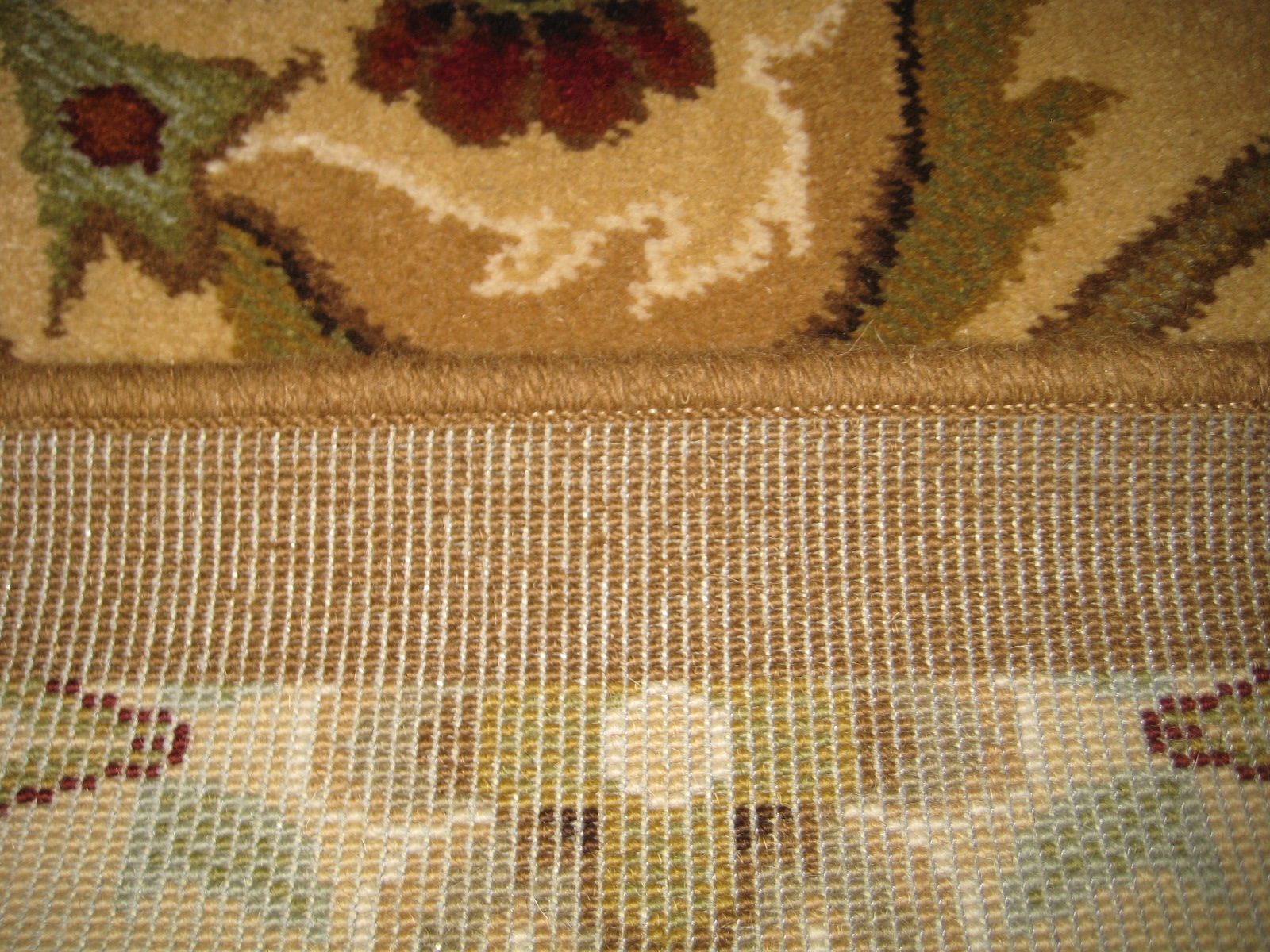
One of the best ways to tell the difference between hand knotted and machine made rugs is to look at the back of the rug. In hand knotted rugs the weaving and the knots will be slightly uneven and not perfectly uniform. On the other hand, a machine made rug will look very uniform and perfectly even. The more detail in the design when looking from the back, the better the quality of the rug. 


Back of a Hand Knotted Rug. Note the fringe is part of the rug.


Back of a Machine Made Rug. Note that the fringe is sewn on.


Look at the Fringes of the rug 

Another way to determine if a rug is hand knotted or machine made is to look at the fringes. As you can see from the picture above, the fringe of a Machine made rug is sewn on and is attached as a finishing touch. 

The fringe of a hand knotted rug is an extension of the rug foundation, as in the picture below.


The foundation of a Hand Knotted rug becomes the fringes.


We hope this has been helpful! Come by our showroom and we will be happy to help you find the perfect rug for your home or office!


Mark Gonsenhauser's Rug and Carpet Superstore

4153 Virginia Beach Blvd.
Virginia Beach, VA 23452
Cleaning Dept: 757-333-1010
Store: 757-486-6600


Website: http://www.igotyourrug.com/


Proudly providing you with Hand knotted, Hand crafted and Machine made rugs for the Hampton Roads cities of Virginia Beach, Norfolk, Chesapeake, Portsmouth, Suffolk, Hampton, Newport News. 


Friday, October 16, 2009

What Size Rug Do I Need?


Rug size depends on furniture scale and placement

How to Measure Your Space for the Correct Rug Size


LIVING ROOM, FAMILY ROOM, DEN, GREAT ROOM:

Place your furniture where you think is best for the room. Measure the open space up to the legs of your sofa and chairs, making sure that when seated, both of your feet should be on the rug. Allow approximately 8-12 inches of exposed floor between baseboards and rug on all sides. More than one rug is acceptable.

DO anchor your rug to the furniture.

DON’T "float" a rug in a room. Scale is important. A too small rug under your coffee table will make the room look out of proportion.


DO use more than one rug if needed to divide the room into separate areas.


DINING ROOM:

DO use your dining room chairs to help you measure what size rug you’ll need. Pull the chairs away from the table, as you would to sit down, on both sides and the ends. Measure from the rear chair legs in width and length. Add 8 inches to this total measurement. This will give you the minimum size rug needed.


Your dining room rug should be large enough to
leave plenty of rug behind the chairs


BEDROOMS:

If the rug is under the bed, allow 3 feet of exposed rug on both sides of the bed. You can also place 2 smaller rugs on either side of the bed. A large rug can also be placed at the bottom of the bed. See picture below.


Large rug placed at the bottom of the bed


GENERAL:

DO try to allow about 8 inches of exposed floor around the baseboards on all sides when using a rug to cover most of the floor in a room. More than one rug is acceptable.

DON’T place a rug in a room so that it ends in the middle of the doors or archway openings.


Mark Gonsenhauser's Rug and Carpet Superstore
4153 Virginia Beach Blvd.
Virginia Beach, VA 23452
Cleaning Dept: 757-333-1010
Store: 757-486-6600


Website: http://www.igotyourrug.com/


Proudly providing you area rugs and rug pads for the Hampton Roads cities of Virginia Beach, Norfolk, Chesapeake, Portsmouth, Suffolk, Hampton, Newport News. 


Friday, September 25, 2009

How to Choose an Oriental Rug


Believe it or not, handmade Oriental rugs fall into the category of art work. Unlike paintings and sculpture, Oriental rugs can be used throughout their lifetime and represent one of the best investments you can make. They can be enjoyed as an art form, useful in their utility as a floor covering and represent an investment that may appreciate in value over time. They can also be passed down from generation to generation as it is not uncommon to find hand knotted rugs over 100 years old that remain in usable condition.

At 50 years an Oriental rug is considered semi-antique.

At 100 years an Oriental rug is considered an antique.


The 3 fundamentals of an authentic Oriental rug are:


• It must be made of natural fibers. (Wool, cotton or silk).

• It must be woven or knotted completely by hand.

• It must be of "Asiatic" origin such as Iran, India, Russia, China, Tibet, Nepal, Morocco; hence the term, “Oriental rug”.

Machine made Oriental design rugs lack at least one of these requirements and usually only last about 15-20 years. Where-as a high quality hand made rug, if properly maintained, can last 3 or 4 generations. 


An Oriental rug may be genuinely hand made, but still not be of fine quality. The quality of an Oriental rug is dependent upon the use of the finest wools, the truest of color-fast dyes, and the most skillful hand-weaving techniques.


Some factors that determine the quality of Oriental rugs are:


• Consistent weave; are there flaws in the weave? Look on the back side of the rug to detect irregular weaving.
• The rug should lie smoothly on the floor; does it ripple, pucker or wrinkle?
• Consistent dyes; is the dye colorfast? Compare the colors on the front and back of the rug to determine if the rug has faded.
• Straight edges and ends; the selvedges or the sides of the rug should be straight and properly secured.
• Width dimensions should be the same at both ends.
• Well finished ends; is the fringe straight and neatly cut? Rugs with-out fringe should have ends that are finished in a neat and secure manner.
• Good long-staple, high elevation wool.
• High knot count; the tighter the knot, the higher the knot count and therefore the rug tends to be more valuable. 

• Has the carpet been washed; this should have been a light soap and water wash. (Once you have purchased your rug it is best to let a professional rug dealer clean it for you).


Mark Gonsenhauser's Rug and Carpet Superstore
4153 Virginia Beach Blvd. 
Virginia Beach, VA 23452
Cleaning Dept: 757-333-1010
Store: 757-486-6600


Website: http://www.igotyourrug.com/


Proudly providing you Decorative Oriental rugs for the Hampton Roads cities of Virginia Beach, Norfolk, Chesapeake, Portsmouth, Suffolk, Hampton, Newport News.